
No products in the cart.

Planning for the Future: 5 Things to Know Before Choosing Fertility Freezing
In simple terms, fertility freezing is a medical method to preserve eggs for women or sperm for men to have babies later in life. This reproductive technology provides a proactive family planning option for various personal, professional, or medical reasons without affecting future health.
Why Do People Opt for Fertility Preservation?
Many individuals choose to hit “pause” on their biological clock for several reasons:
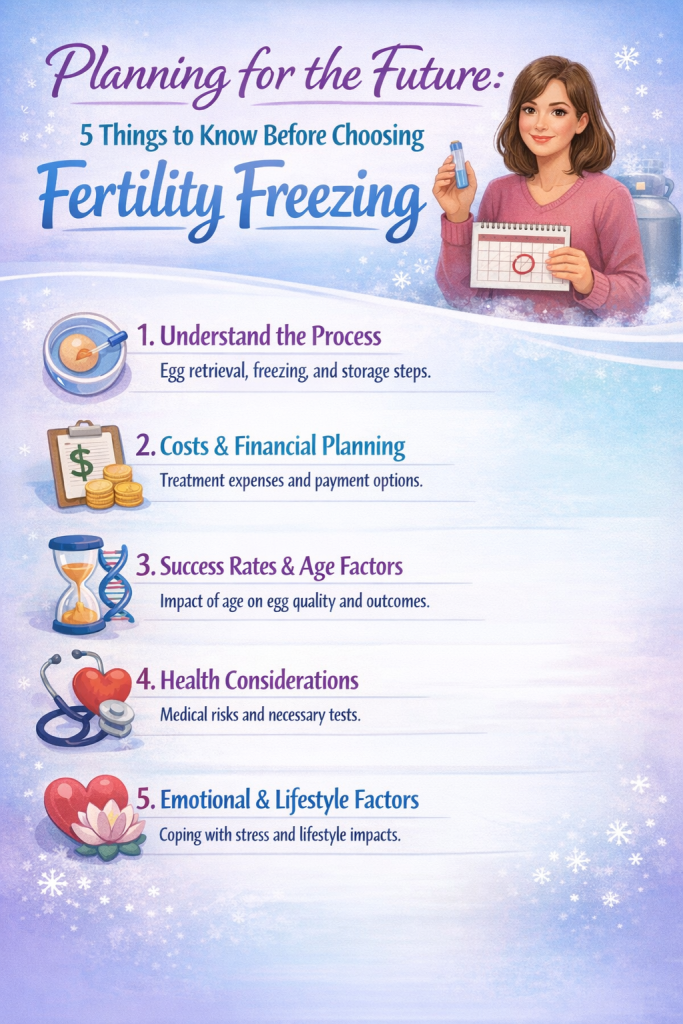 A helpful guide highlighting the key factors to consider before choosing fertility freezing, including process, costs, success rates, health, and emotional impact.
Medical Treatments: Such as chemotherapy that might affect reproductive health.
Career & Education: Prioritizing professional goals before starting a family.
Social Reasons: Waiting for the right partner.
Gender-Affirming Care: For transgender individuals before transitioning.
Why Do Men And Women Opt To Freeze Their Fertility Freezing?
People choose to freeze their eggs or sperm for a variety of deeply personal and practical reasons. The most common include:
Career and Education: Many individuals want to reach specific professional milestones before starting a family.
Medical Treatments: Procedures like chemotherapy or certain surgeries can impact fertility Freezing. Freezing acts as a safeguard.
Biological Clock: Fertility Freezing naturally declines with age. Freezing “locks in” the quality of cells from a younger version of yourself.
Finding the Right Partner: It takes the pressure off the dating process, allowing you to wait until you’ve found the right person to co-parent with.
The Process Of Egg Or Sperm Freezing
The timelines for these two procedures are quite different due to the biological complexity of the cells involved.
➯ Sperm Freezing (1-Day Process):
For men, the process is straightforward and can often be completed in a single visit.
Consultation & Testing: Screening for infectious diseases. Anti-Mullerian Hormone or AMH test
Sample Collection: Providing a semen sample at the clinic.
Analysis: The lab checks sperm count and motility.
Cryopreservation: The sample is frozen in liquid nitrogen and stored indefinitely.
➯ Egg Freezing (2–4 Week Process):
For women, the process is more involved as it requires stimulating the ovaries to produce multiple eggs.
Ovarian Stimulation: You take hormonal injections for about 8–12 days to encourage follicle growth.
Monitoring: Frequent ultrasounds and blood tests to track egg development.
Trigger Shot: A final injection to help the eggs reach peak maturity.
Egg Retrieval: A 15-minute surgical procedure performed under light sedation.
Vitrification: The eggs are “flash-frozen” to prevent ice crystal formation.
The Right Age For Freezing Your Eggs Or Sperm Cells
Timing is everything when it comes to the success rate of these procedures.
| Category | Recommended Age Range | Why? |
| Egg Freezing | 25 to 35 years old | Egg quality and quantity begin to drop significantly after 35. |
| Sperm Freezing | Late 20s to early 40s | While men produce sperm throughout life, DNA fragmentation increases with age. |
When it comes to fertility Freezing, timing is a biological reality. While the “right” age is a personal decision based on your career and life goals, there are clear medical windows where the quality of your cells is at its peak.
Here is a breakdown of the ideal timelines for both women and men.
➯ For Women: The Ideal Window for Egg Freezing
For women, the quantity and quality of eggs are finite and Ejaculate over time.
The “Golden” Window (Ages 27–34): This is generally considered the best time to freeze. At this age, you likely have a high ovarian reserve, and the eggs are less likely to have chromosomal abnormalities.
The Efficiency Window (Ages 35–37): Many women freeze during this period. While the egg count starts to dip, the success rates for a future healthy pregnancy remain relatively high.
The Later Window (Ages 38–40): Freezing is still possible, but doctors may recommend multiple retrieval cycles to collect enough healthy eggs to ensure a high probability of a future birth.
Key Fact: Eggs frozen at age 30 have a much higher “thaw-to-birth” success rate than those frozen at age 40, because the internal structure of the egg is more stable in your 20s and early 30s.
➯ For Men: The Ideal Age for Sperm Freezing
While men produce sperm throughout their lives, the genetic integrity of that sperm changes as they age.
The Peak Period (Before Age 40): For the highest quality samples, men are encouraged to freeze before 40. Sperm at this stage typically has high motility (swimming ability) and low DNA fragmentation.
The Transition Period (Ages 40–45): After 45, research shows an increase in the time it takes to conceive and a slight increase in the risk of certain genetic conditions or neurodevelopmental issues in offspring.
Medical Necessity: Regardless of age, men should consider freezing immediately if they are about to undergo testosterone replacement therapy, chemotherapy, or a vasectomy.
Risks Of your Fertility Freezing
Understanding the potential side effects helps you prepare for the process and know when to contact your medical team.
➯ Risks for Women (Egg Freezing):
The journey involves several stages, each with its own set of considerations:
Common Side Effects: During the 10–12 days of hormone injections, many women experience symptoms similar to PMS. This includes bloating, breast tenderness, mood swings, and mild injectionsite bruising or soreness.
Ovarian Hyperstimulation Syndrome (OHSS): In rare cases, the fertility drugs cause the ovaries to overreact and become swollen and painful. While most cases are mild, severe OHSS can cause rapid weight gain, abdominal pain, and nausea. Modern protocols have significantly reduced the risk of this occurring.
Surgical Complications: The egg retrieval is a minor surgical procedure performed under sedation. As with any procedure involving a needle and anesthesia, there are very slight risks of infection, bleeding, or damage to the bowel, bladder, or blood vessels. These complications occur in less than 1% of cases.
Ovarian Torsion: Because the ovaries become enlarged during the stimulation process, they can occasionally twist on their own axis. This is known as torsion and can cut off blood supply. Patients are usually advised to avoid high-impact exercise or twisting movements during the final days of the cycle to prevent this.
➯ Risks for Men (Sperm Freezing):
While the collection itself is risk-free, the primary “risks” involve the viability of the cells and the long-term success of the procedure.
Sample Degradation During Thawing: The most significant risk is that not all sperm cells survive the cryopreservation process. Even with modern technology, some cells may lose motility (the ability to swim) or suffer structural damage when thawed years later.
Low Initial Sperm Quality: If a man has a low sperm count or poor morphology at the time of freezing, the sample may not be robust enough to survive the freezing and thawing cycle. This could result in a non-viable sample when it is finally needed for IVF or IUI.
Genetic Integrity Concerns: Freezing does not “fix” existing genetic issues. If the sperm is frozen at an older age (typically over 45), there is a higher risk of DNA fragmentation, which can lead to lower fertilization rates or a slight increase in certain health conditions for the offspring.
Equipment or Lab Failure: Though extremely rare, there is a technical risk of equipment malfunction or power failure at the storage facility. Most reputable clinics use redundant backup systems and liquid nitrogen sensors to prevent the loss of samples.
Shared Psychological & Long-Term Risks
Choosing to freeze your fertility freezing is a significant life event that carries its own set of unique stressors.
The “False Sense of Security”: One of the biggest psychological risks is viewing frozen eggs or sperm as a guaranteed baby. In reality, these are “possibilities.” If a person delays natural conception too long relying solely on their frozen samples, they may face heartbreak if those samples do not lead to a successful pregnancy later.
Decision Fatigue & Future Dilemmas: What happens to the samples if they are never used? Many people face emotional distress years later when deciding whether to discard the samples take gestational diabetes, donate them to research, or keep paying storage fees indefinitely.
Financial Stress: The cost of fertility freezing is high. Between the initial procedure and annual storage fees, the long-term financial commitment can become a source of anxiety, especially if your financial situation changes over the years.
Relationship Complexities: If you freeze embryos (egg + sperm) with a partner and later break up, legal battles over who “owns” the fertility freezing can be devastating. This is why many experts suggest freezing eggs or sperm individually rather than as embryos.

Publicpill