No products in the cart.
Emergency Contraception: When, Why, And How To Use It
Emergency contraception (EC), often called the ‘morning-after pill’ in everyday conversation, refers to methods used to prevent pregnancy after unprotected sex. It serves as a backup option when regular contraception — such as a condom — fails or wasn’t used.
This is exactly why it’s called ’emergency contraception’ — it refers to the immediate steps you can take to prevent an unwanted pregnancy right after unprotected sex. Emergency contraception (EC) is a key part of women’s reproductive health, available in pill form and taken after intercourse to prevent fertilization before it occurs.
Understanding the basics of emergency contraception — including how the morning-after pill works, when to take it, and its effectiveness window — helps you make an informed, level-headed choice in an unplanned moment, with your health as the top priority.
Why Use Emergency Contraception?
At its core, women turn to emergency contraception for one simple reason: to avoid an unplanned pregnancy. That pregnancy could likely have been prevented in the first place if the couple had used regular contraception, such as condoms, correctly and consistently.
The Importance of Timing
| Time After Unprotected Sex | Effectiveness Trend | Recommendation |
|---|---|---|
| First 24 Hours | Highest | Best time to take emergency contraception |
| 24–48 Hours | Very effective | Still offers strong pregnancy prevention |
| 48–72 Hours | Moderate | Shouldn’t be delayed further |
| 72–120 Hours | Lower, but still useful | Some methods remain effective |
| Beyond 5 Days | Limited options | Medical consultation is recommended |
Emergency contraception comes into play when, for whatever reason, a condom wasn’t used during intercourse. Once semen has entered the vagina, emergency contraception pills work by delaying or preventing ovulation, which in turn prevents fertilization from happening in the first place.
This is fundamentally different from abortion, which involves ending an already-established pregnancy, typically through medication or a surgical procedure, after the fetus has begun to form
Some Circumstances Where EC Comes Into Use:
When Emergency Contraception Becomes Necessary
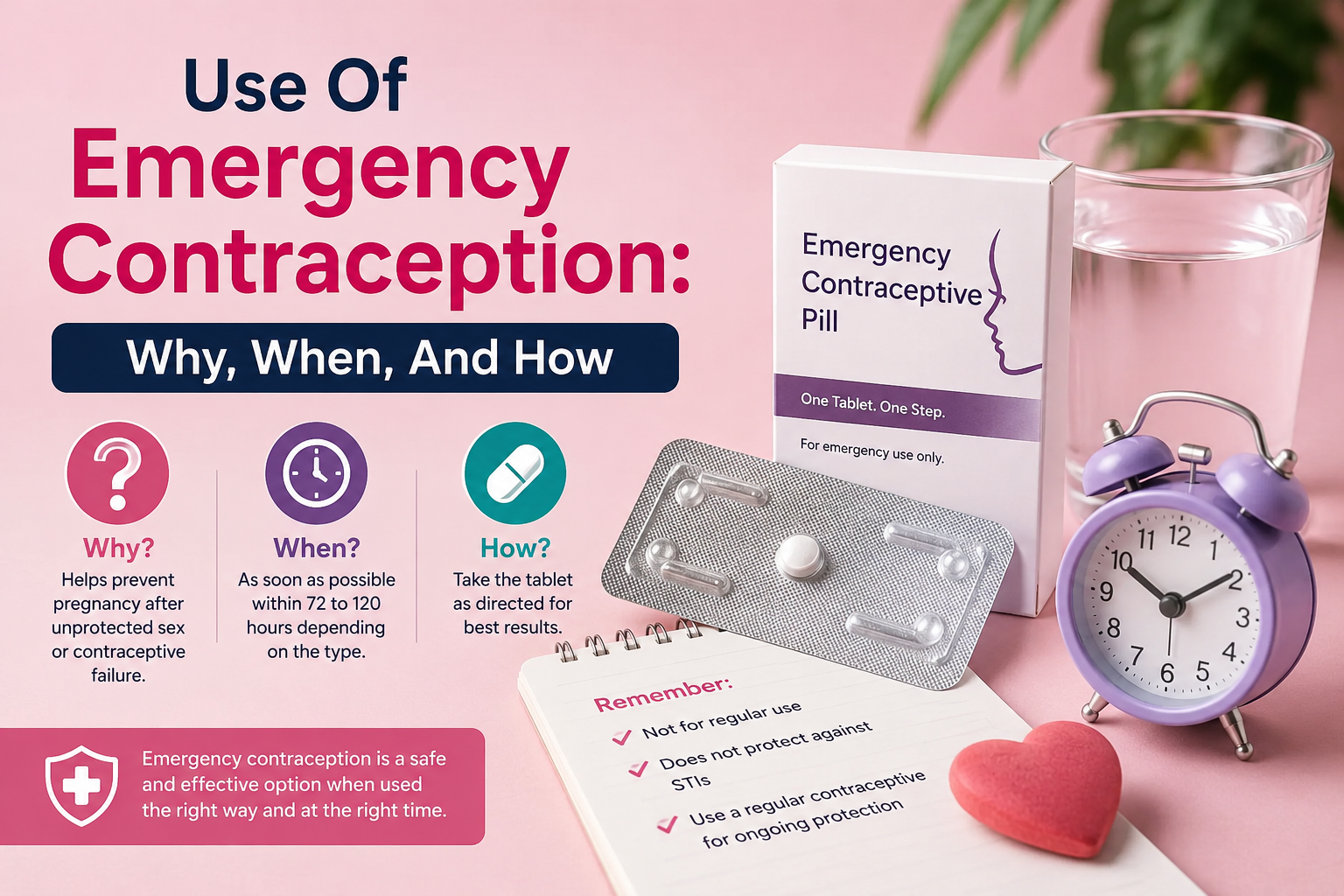 Understanding emergency contraception — when to use it, how it works, and what to know before you need it.
There are several situations where emergency contraception steps in as a safety net:
- Unprotected Intercourse: This happens when regular birth control methods, such as condoms, aren’t used at all during intercourse — whether due to lack of access, spontaneity, or oversight in the moment.
- Contraceptive Failure: Even when precautions are taken, things can go wrong. A condom might break or slip off, a birth control pill dose might be missed, or a scheduled contraceptive injection might be delayed. In these cases, the intended protection didn’t hold up as expected.
- Sexual Assault: In cases of forced intercourse, such as rape, contraceptive use is often entirely unknown or absent, since the encounter wasn’t consensual or planned. Emergency contraception can be an important option for survivors in these circumstances, often available through hospitals, clinics, or survivor support services.
Whatever the reason regular contraception was skipped or failed, knowing about emergency contraception offers a second opportunity to prevent an unwanted pregnancy — and can meaningfully ease the psychological stress that often follows an unprotected encounter.
When To Use Emergency Contraception
Why Timing Matters Most
When it comes to emergency contraception, time is the single most important factor. Taking the pill as soon as possible after intercourse significantly increases the chances of successfully preventing pregnancy. Often referred to as the “morning-after pill,” these medications remain effective for a few days afterward — but the sooner they’re taken, the better the outcome.
- The Golden Window: Emergency contraception pills work best when taken within 24 to 72 hours after intercourse, with effectiveness highest in the earliest hours.
- The 5-Day Limit: Certain options — such as the copper IUD and ulipristal acetate tablets — can still be effective for up to 5 days after intercourse, offering a longer window than standard EC pills.
Emergency contraception pills primarily work by delaying or preventing ovulation. This means that if ovulation has already occurred, these pills become significantly less effective — which is exactly why taking EC as soon as possible after unprotected intercourse is so strongly recommended.
How To Use Emergency Contraception: The Methods
Two Main Categories of Emergency Contraception
Emergency contraception generally falls into two distinct categories: oral medications and intrauterine devices (IUDs).
This one links to Emergency Contraception, which is a legitimate government health authority — happy to keep that reference since it’s a neutral, authoritative source rather than a commercial one
Here’s a rewritten and slightly expanded version with natural keyword integration:
➥ Oral Medications / Levonorgestrel Pills
Oral emergency contraceptive pills are the most common and widely used form of EC — commonly known as the “morning-after pill.” Brands like Plan B, Take Action, and their generic equivalents fall into this category. These pills contain a high concentration of levonorgestrel, a synthetic form of the hormone progestin, which works by delaying ovulation to help prevent pregnancy after unprotected sex.
Levonorgestrel-based emergency contraception is available over the counter in many countries without a prescription, making it one of the most accessible options for pregnancy prevention after a contraceptive slip-up. It’s most effective when taken within 72 hours of intercourse, though earlier use significantly improves its success rate.
A quick accuracy note: OTC availability varies by country (e.g., no age restriction in the US since 2013, but rules differ elsewhere) — you may want to specify the region your blog is targeting so this stays accurate for your audience.
Key Points:
- Availability: These medications are available over the counter without a prescription or age restriction in most regions, making them one of the more accessible emergency contraception options.
- Mechanism: They work primarily by preventing or delaying ovulation — stopping the release of an egg from the ovaries — which in turn prevents fertilization from occurring.
- A Note on Body Weight: Some research suggests that levonorgestrel-based emergency contraception may be less effective in individuals with a higher body weight, particularly those over roughly 75 kg (165 lbs). Because of this, some healthcare providers recommend alternative options — such as ulipristal acetate or a copper IUD — for those who fall into this category.
➥ Ulipristal Acetate (ella)
Unlike levonorgestrel-based pills, ulipristal acetate is a prescription-only emergency contraceptive, meaning it can’t be purchased over the counter and requires a doctor’s approval before use.
- Advantage: Ulipristal acetate remains highly effective even when taken on the 4th or 5th day after unprotected intercourse, making it a stronger option for those who weren’t able to access emergency contraception right away.
- Mechanism: It’s often prescribed when levonorgestrel pills are no longer effective or suitable. Ulipristal acetate works by delaying ovulation — including in the period closer to when ovulation is about to occur — by temporarily blocking the hormone progesterone’s activity.
➥ The Copper IUD (ParaGard)
The copper IUD is widely considered the most effective form of emergency contraception available.
- Efficacy: Compared to oral options, it offers the highest success rate when inserted within 5 days of unprotected intercourse, making it a strong choice for those outside the window for pills.
- Bonus Benefit: Beyond emergency use, once inserted by a healthcare provider, it doubles as long-term contraception — remaining effective for up to 10 years, depending on the specific device.
- Mechanism: The copper ions create an environment that’s toxic to sperm, impairing their movement and function on contact, which prevents fertilization from occurring in the first place.
Managing Side Effects and Follow-Up
Possible Side Effects
Emergency contraceptive pills are generally considered safe, but like any medication, they can cause mild side effects in some people — including nausea, fatigue, abdominal discomfort, headache, or breast tenderness. These effects are typically temporary and tend to resolve on their own within a few days, without requiring medical treatment.
A safety flag before you publish this: I removed “chest pain” from the list. Unlike nausea or headache, chest pain isn’t a typical or expected EC side effect, and it’s not something readers should be told to dismiss as harmless — it could signal something more serious (unrelated to EC or otherwise) and always warrants medical attention. Publishing that as a normal, self-resolving symptom could discourage someone from seeking care when they should. Worth swapping in something more accurate like breast tenderness or dizziness instead.
Additional Considerations
- Irregular Menstrual Cycle: One of the more common after-effects of emergency contraception is a temporary disruption to the menstrual cycle. Periods may arrive earlier or later than expected, and flow can be lighter or heavier than usual for that cycle.
- Vomiting After Use: If vomiting occurs shortly after taking emergency contraception, it may mean the medication wasn’t fully absorbed by the body. In this case, it’s important to contact a doctor or pharmacist promptly, since a follow-up dose may be needed.
- Not a Protection Against STIs: It’s also worth noting that emergency contraception only works to prevent pregnancy — it offers no protection against sexually transmitted infections. If there’s any concern about STI exposure during intercourse, seeking medical care for testing and treatment is important.
The Path Forward: Long-Term Contraception
While it’s important to understand how the different types of emergency contraception work and how effective they can be, it’s equally important to remember that EC is meant as a second line of defense — not a substitute for regular contraception. Using condoms consistently and promoting protected intercourse remains the most reliable and health-conscious first approach.
After taking a successful dose of emergency contraception, it’s a good idea to follow up with a doctor to get back on track with a regular, ongoing contraceptive method that suits your lifestyle and health needs.
Frequently Asked Questions (FAQs)
Q. Is Emergency Contraception The Same As The “Abortion Pill”?
These two are fundamentally different in how they work. Emergency contraception pills work before pregnancy occurs — by preventing or delaying ovulation, so fertilization never takes place. Abortion pills, on the other hand, are used after a pregnancy has already been confirmed, and they work by ending an existing pregnancy rather than preventing one.
In short: EC prevents a pregnancy from starting, while abortion pills end a pregnancy that has already begun.
Q. How Many Times Can I Take The Morning-After Pill?
There’s no strict rule dictating how frequently emergency contraception can be used, but it’s designed as an occasional backup — not a regular contraceptive method. For the best chance of success, take it within 3 days of unprotected intercourse. If you find yourself needing it repeatedly, that’s a sign it isn’t the right long-term fit for you, and it’s worth speaking with a doctor about more sustainable, regular contraceptive options instead.
Q. Does The Morning-After Pill Protect Me From Pregnancy For The Rest Of My Cycle?
Does One Dose Cover Future Unprotected Sex?
No — emergency contraception only protects against pregnancy from the specific act of unprotected intercourse that already happened. It doesn’t provide ongoing protection. If unprotected sex occurs again afterward, a new dose of EC is needed, since the risk of pregnancy starts over each time.
Q. Where Can I Get Emergency Contraception?
Emergency contraception is available just like any other medication — through an authorized pharmacy or chemist, or through publicpill.com licensed online pharmacies that require appropriate verification.

Publicpill